As we look ahead to the European Convention of Engineering Deans (ECED) 2026, held from…
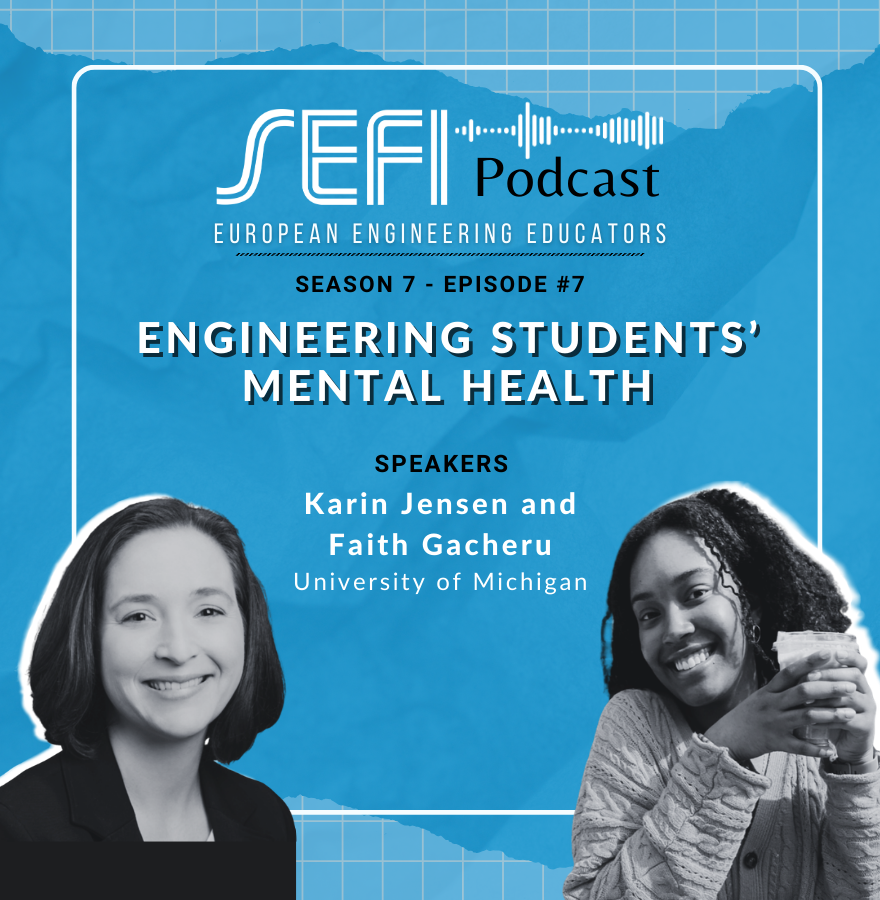
Concerns for student mental health have grown over the last decade, particularly within engineering disciplines, which are often associated with heavy workloads and difficult assessment. There is subsequently an increasing need to understand the stressors that impact engineering students, and the ways in which we can support them to thrive.
In this episode we speak to Karin Jensen, an Assistant Professor and Faith Gacheru a first-year graduate student, both from the University of Michigan. Karin was awarded a CAREER award from the National Science Foundation for her research on undergraduate mental health in engineering programs and recognized with a Presidential Early Career Award for Scientists and Engineers, awarded by US President Biden in January 2025, whilst Faith recently presented a poster entitled A Mixed-Methods Study to Support Undergraduate Engineering Student Well-Being at ASEE 2025.
Key terms and definitions
Karin explains that one of the key challenges within the research space is the variety of terms that are used interchangeably, some being associated with clinical definitions. To this end, a finding of her research has been that students are confused by the terminology used, this having important implications for the way we think about interventions and support for students, as well as how we communicate. Faith adds to this by explaining that stress is a response that people can have to a challenging situation or change in our environment, whereas wellbeing describes the overall state of someone and includes physical, financial and social health. Karin expands on this by explaining that stress is commonly labelled as negative but that, in fact, it is a normal part of everyday life and can be positive, increasing performance. She differentiates this from chronic or extremely high stress which can impact physical and mental health. In comparison to stress, which is more about the present, anxiety, is considered to be more about anticipation.
Mental health trends
Karin explains that research indicates an increase in mental health challenges experienced by college students and the youth more generally over recent years and refutes the idea that normalising having conversations around mental health concerns helps drive these trends. She claims that there is a big difference between normalizing talking about mental health and normalizing the idea that engineering students should experience very high levels of chronic stress and instead believes that it is important we talk more about mental health and offer support.
The role of culture
Karin describes the use of organisational culture frameworks in her work, this including expected behaviours, norms and values of a particular space. In the case of engineering culture, it has been found that students believe that they are not viewed as successful if they seek mental health support, this discouraging help-seeking behaviour. She explains that this is, in part, a result of engineering being viewed as more difficult and rigorous and requiring more time and dedication, than other subjects.
Measuring stress
Karin describes a larger study undertaken by the research group which involved collecting qualitative data from students which was used to develop pilot items for development of a survey. They then did some exploratory factor analyses that allowed for identification of potential subscales, followed by confirmatory factor analyses on separate data sets to validate and refine the use of the items. Although there were existing stressor measures, the set of subscales on stressors developed were specific to engineering students and thus took account of the assumptions, values and norms associated with the engineering culture.
Longitudinal study
Karin explains that the items were used as part of a multi-year longitudinal study whereby the same students were surveyed multiple times a semester over several years. They found stress to be highly variable across semester and over the course of a year. In comparison, measures of stress culture and perceptions of what is normal or expected were steadier, but increased over time, suggesting enculturation.
The views of educators and faculty
Karin explains that most staff they have spoken to are concerned about mental health and that they want to support students, but that they don’t necessarily feel prepared, don’t have the training or know how to best interact with, and support, students.
However, she also explains that it is important that faculty recognise their own limitations and the impact that this has on their own health and well-being. She explains that there is work to be done in resourcing and supporting faculty, as well as in developing strong communities which can start to challenge the negative cultural aspects.
Teaching practice
Karin describes the development of a module that makes use of biometrics and involves students learning about the physiology of stress and how it can be measured using different devices, as well as data analysis and interpretation. The module now involves technical communication, statistics and learning about patents. This allows students to learn about the technology, which is integral to biomedical engineering, and practical, evidence-based strategies to support their own well-being. Karin explains that, whereas topics such as mental health and wellbeing are often viewed as separate to engineering, that students were more convinced by looking at quantitative data associated with physiological change. This course was particularly impactful because students, who tend to believe that interventions such as meditation or mindfulness only work for other people, could measure their own physiology.
Key takeaways
Karin reminds us that wellbeing is a state rather than something to be achieved or a destination. She says that centring wellbeing involves mindset and influences how we approach all that we do. Faith adds that wellbeing is not one-size-fits-all and that your approach to it should make sense for you.
Resources
Jensen, K. J., & Cross, K. J. (2021). Engineering stress culture: Relationships among mental health, engineering identity, and sense of inclusion. Journal of Engineering Education, 110(2), 371-392.
Mirabelli, J. F., Johnson, E. M., Vohra, S. R., Sanders, J. L., & Jensen, K. J. (2025). Stressors and normalized stress in undergraduate engineering education culture: development of the Engineering Stress Culture Scale and Undergraduate Engineering Stressors Questionnaire. International Journal of STEM Education, 12(1), 19.
Details about Karin’s lab and work can be found here: https://kjens.engin.umich.edu/
Related Posts