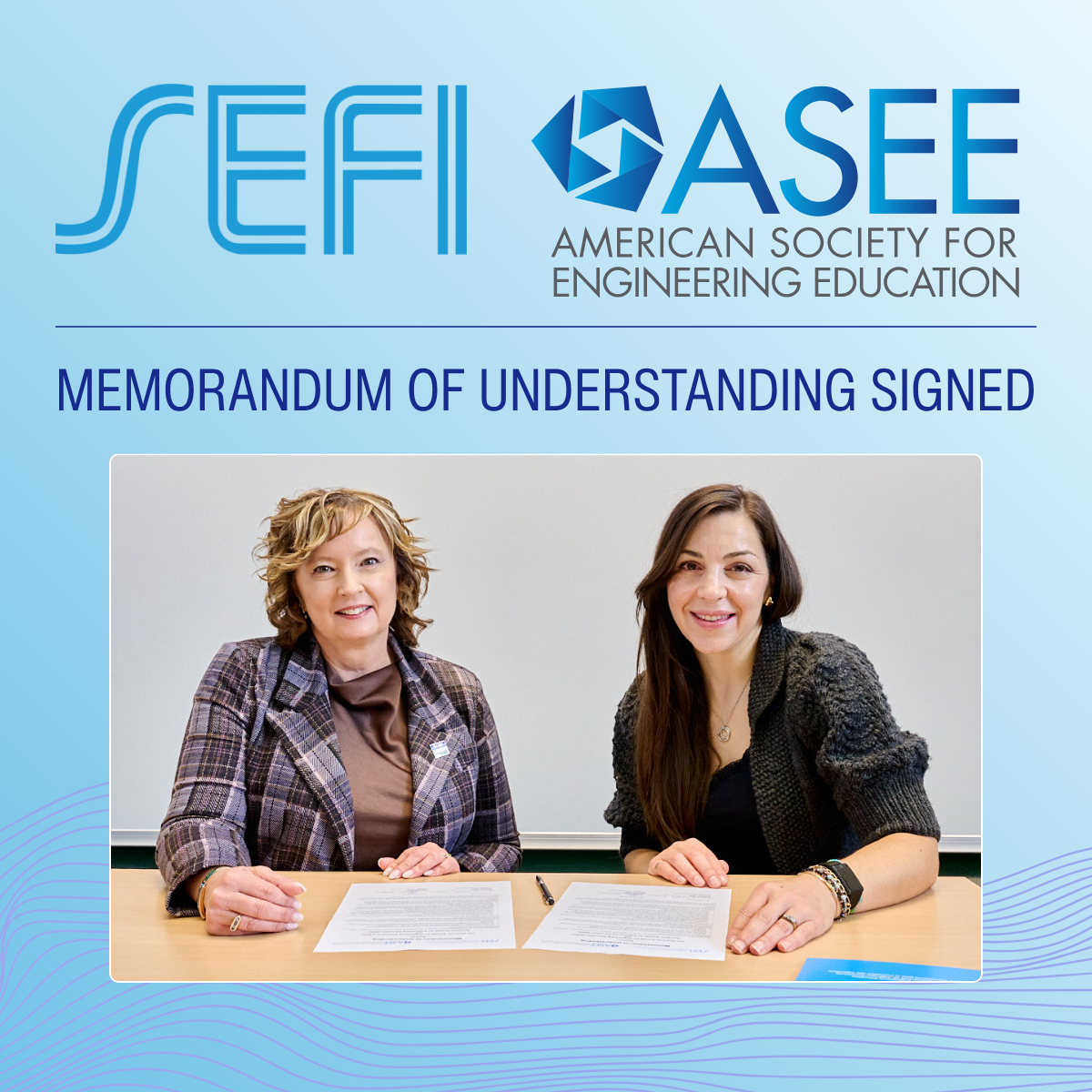
SEFI has renewed its Memorandum of Understanding with the American Society for Engineering Education (ASEE). It was signed on the 10 September 2026, at the SEFI Annual Conference in Prague, by presidents Agnieszka Miguel (ASEE) and Emanuela Tilley (SEFI).
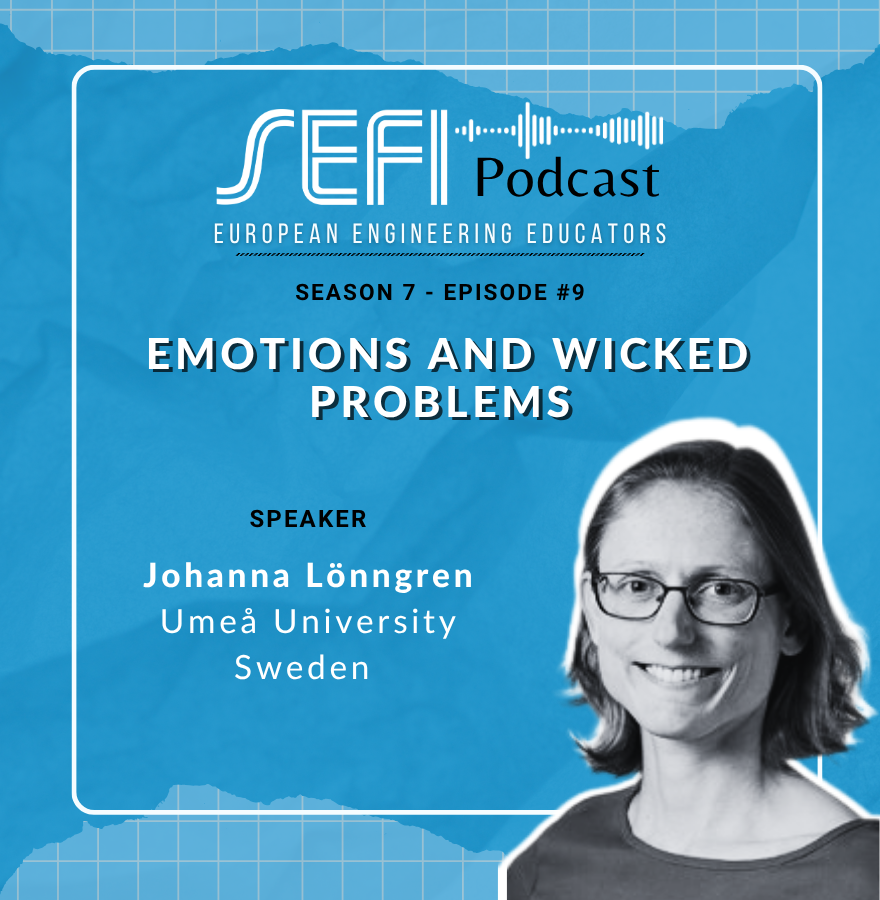
Engineering students are increasingly expected to work towards solving ‘wicked’ problems. Tacking such complexity can invoke a range of emotions and educators are increasingly required to support students in situations when they are confronted with uncertainty and value conflicts.
In this episode we speak to Johanna Lönngren, Associate Professor in Science and Engineering Education at Umeå University. Johanna is part of the Umeå Science Education Research (UmSER) group and focuses on the role of emotions in education for sustainable development, exploring how engineering students talk about, and collaboratively deal with, emotions when they work with complex sustainability problems.
The remainder of this article will summarise the key discussion points.
Johanna’s journey
Johanna explained that although she loved her own engineering studies, she had become frustrated that there was no space to discuss broader societal issues such as ethics and sustainability. However, in her final year she did get the opportunity to co-develop and teach a new sustainability course which involved role playing different societal stakeholders. For some, this was meaningful, but some experienced anxiety and frustration. This inspired Johanna to work on helping students become more comfortable in facing complex problems, this leading her to study a PhD at Chalmers University of Technology in Gothenburg, also in Sweden.
Wicked Problems
The term ‘wicked problems’ was coined in the 1960s and 70s, when it was claimed that social problems were fundamentally different from natural science problems and therefore could not be solved with the same methods. Social problems were consequently defined as wicked, characterised by high degrees of uncertainty and ambiguity, where it is not possible to agree among all stakeholders on how a problem should be solved or even framed.
Climate change is considered to be one of the most widely used examples of a wicked problem, involving multiple stakeholders and requiring us to balance conflicting technical, social, environmental and economic values.
Wicked problems within engineering education
Johanna explains that truly wicked problems are not often considered within engineering curricula. Although educators introduce authentic case studies and scenarios, time and resource limitations mean that students do not often get to interact with real stakeholders or negotiate conflicting interests and values while also ensuring sound technical design.
Cultural-historical activity theory (CHAT) involves learning through the development of new ideas, practices, and collective agency. Students are positioned, not just as passive recipients of existing knowledge, but as active co-creators of new knowledge. That is particularly important when considering sustainability, because existing knowledge and practices have clearly not been successful in securing a sustainable future for all.
This kind of learning can trigger strong emotional reactions among engineering students. However, very few engineering courses are designed to help students and educators deal with those emotional reactions and to stay with the uncomfortable uncertainty rather than reducing the uncertainty at the expense of social and environmental justice.
Defining Emotions
Johanna explains that there are many different ways of conceptualizing emotions. In education research, a commonly used framework is Pekrun et al.’s academic emotions which include:
- achievement emotions, reactions to perceived success or failure (e.g. pride over a good grade or anxiety before an exam)
- epistemic emotions, related to learning processes (e.g. enjoyment of gaining an insight or frustration when experiencing cognitive conflict)
- social emotions, appraisals of social interaction (e.g. developing friendships or conflicts in group work)
- topic emotions which are about educational content (e.g. fascination for chemical processes or hopelessness regarding climate change)
Although all academic emotions are involved at all times, epistemic emotions are particularly interesting because wicked problems challenge the epistemic norms and traditions in engineering disciplines. Engineering students often get extensive training in solving well-structured problems, where they are provided with all important parameters and apply existing algorithms to obtain the correct solution. They can therefore become overwhelmed, frustrated and give up when faced with a wicked problem.
The role of social interaction
Johanna made use of social interaction theories which view emotions as inherently social phenomena and consider the dynamic interplay between emotions and social structures.
They are concerned with 1.) how peoples’ expression of emotions can influence the social dynamics they are involved in and 2.) how social dynamics can influence who can express which emotions.
Methodologically, this involved the study of interaction and focusing on aspects of emotions that are observable to others (e.g., verbally, through gestures, facial expressions).
Positioning theory can then be used as a framework for analysing social interaction in terms of who is allowed or expected to do what in the interaction and for better understanding how social dynamics in student group work can trigger collective frustration and hopelessness or expansive learning and collective agency for dealing with wicked problems.
It can also be used to explore how teachers might scaffold student groups to constructively deal with epistemic emotions. Scaffolding is about teachers or peers helping students to successfully complete tasks they would not be able to do on their own. Emotional scaffolding is considered as anything that contributes to making specific learning environments emotionally supportive for students, so that students can feel safe enough to explore conflicting values, grapple with uncertainty, and challenge existing norms and structures.
To analyse emotional scaffolding, they needed to look at what students and teachers can do to influence the emotional learning environment. This involved video-recording group work on wicked problems in two sustainability courses for engineering students in Sweden. They wanted to see how students expressed emotions when grappling with epistemic challenges involving uncertainty and ambiguity, and how expressing those emotions may have influenced group dynamics and students’ ability to engage with epistemic challenges.
Analysing the data
The academic emotions framework was used to guide coding of emotions expressed in response to epistemic challenges.
The second part of the analysis involved the use of social interaction theory to understand how the emotions that students expressed influenced their interaction and possibilities for expansive learning. This involved creating interaction maps to visualize who expressed which emotions in response to a specific challenge or to other students’ actions, and how the emotional interactions seemed to support or hinder expansive learning. The same type of emotional responses to the same type of epistemic challenge was found to both lead to deeper engagement with the challenge and to avoidance behaviour.
How can educators support students?
The findings showed that it was important that:
- students get a chance to let go of control and embrace uncertainty through building an emotionally safe learning environment, e.g., through practical exercises in empathic listening, and through concrete tools and strategies for turn taking and for making sure that everyone gets space to contribute
- instructions and assessment primarily focus on the process students engage in as opposed to the solution they come up with at the end
- epistemic challenges are normalised as part of engineering work
- emotional reactions to epistemic challenges are normalised
Supporting development of educators
Johanna claims that educators already have most of the skills they need from being human beings. She instead sees the main problem as being the idea that emotions have no place in engineering education, something which leaves students to figure out how to deal with them on their own and to even feel bad about having emotions in the first place.
Future research
Johanna explains they want to try out some small interventions to develop concrete examples of how teachers can work with emotional scaffolding. Other areas include: stimulating students to reflect about their emotional reactions to epistemic challenges so that they, themselves, can reframe challenges as opportunities for learning; the role of physical artefacts in providing emotional scaffolding; and the development of a framework for multi-level analysis of epistemic emotions in student group work, integrating theories and data from individual, inter-personal and structural levels.
Takeaway
Johanna urges us not to be afraid of emotions and warns that leaving our emotions at the door when we enter a classroom is denying our students important opportunities for learning and ourselves of meaningful teaching experiences.
She also believes that many educators would benefit from training focusing on how to promote emotionally safe learning environments, for example by facilitating activities that help students build trust with and for each other.
Further reading
https://wickedproblemsteaching.wordpress.com/.
https://www.tandfonline.com/doi/full/10.1080/03043797.2025.2474046?scroll=top&needAccess=true#d1e164
Related Posts