19 February 2026
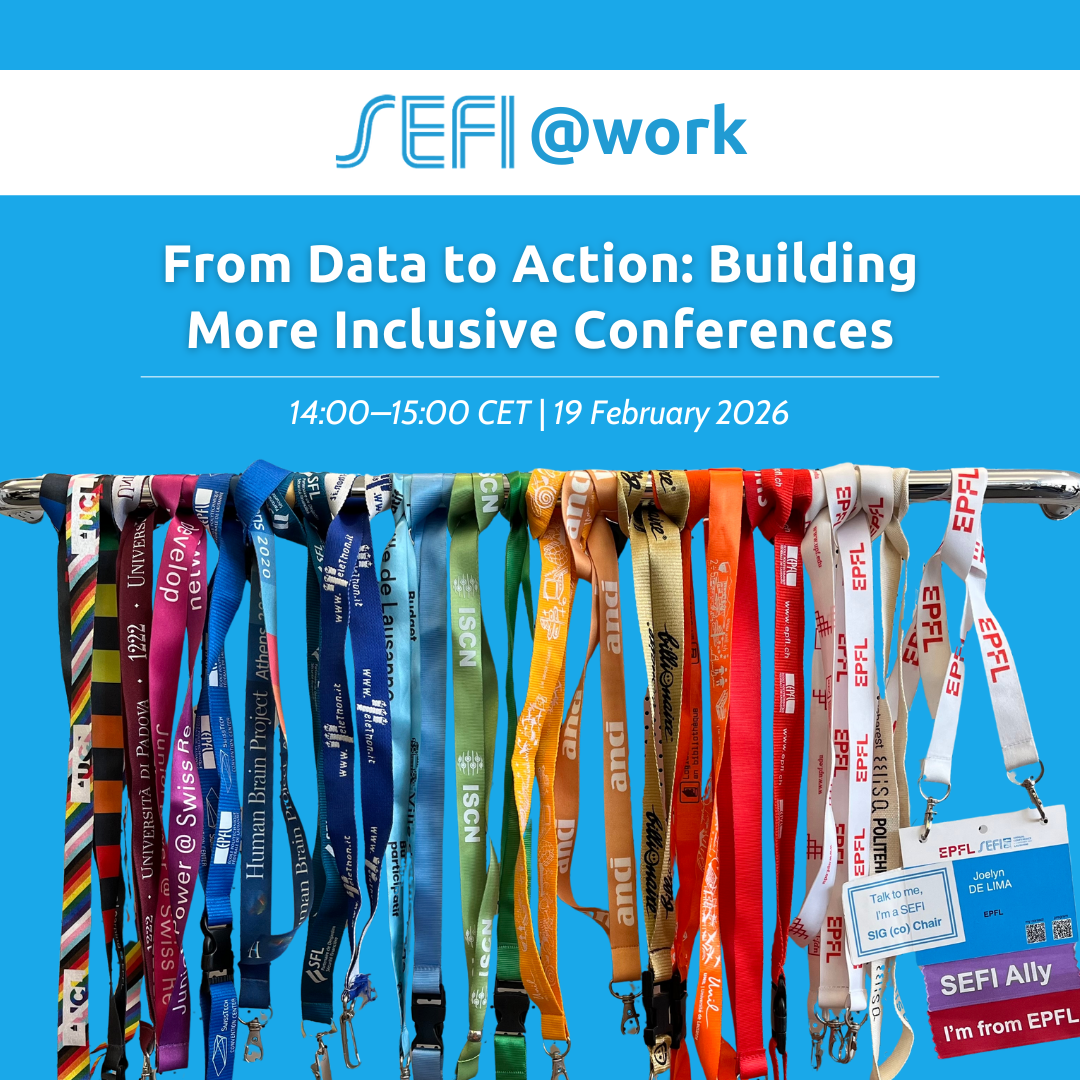
This SEFI@work will provide insights into a study conducted to understand the degree to which identities and lived experiences are supported (or not) by the current SEFI conference structures and processes, specific barriers...
SIG Diversity, Equity and Inclusion
Reflexivity and Positionality statements
– examining the impact of our social identities in engineering education research
Date and time: 6 February 2023 10:00 EST/16:00 CET
Engineering education researchers’ social identities – their backgrounds, world views, experiences and biases – have an impact on their research: research topic, epistemology, ontology, methodology, relation to participants, and communication (Secules et al., 2021).
This is particularly important in engineering education research that integrates critical theoretical frameworks (Mejia, Revelo, Villanueva, & Mejia, 2018). Moreover, As Riley et al. (2014) note, many research studies on diversity in engineering education are “well-intentioned, but…somewhat lacking in reflexivity and self-limiting in their impacts” (p. 335). Recently, journals in engineering education started requiring a positionality statement in each paper published. Such is the case of the Journal of Engineering Education and the Journal of Women and Minorities in Science and Engineering (Martin, Desing, & Borrego, 2002).
In this session, we will discuss the impact of reflexivity and positionality on equity and social justice research.
Speakers:
Stephen Secules. Florida International University, US
Cassandra McCall. Utah State University, US
Joel Alejandro Mejia. University of Texas at San Antonio, US
References:
Secules, S., McCall, C., Mejia, J. A., Beebe, C., Masters, A. S., L. Sánchez‐Peña, M., &
Svyantek, M. (2021). Positionality practices and dimensions of impact on equity research:
A collaborative inquiry and call to the community. Journal of Engineering Education,
110(1), 19–43. https://doi.org/10.1002/jee.20377
Mejia, J. A., Revelo, R. A., Villanueva, I., & Mejia, J. (2018). Critical theoretical frameworks in
engineering education: An anti-deficit and liberative approach. Education Sciences, 8(4),
[158]. https://doi.org/10.3390/educsci8040158
Riley, D., Slaton, A. E., & Pawley, A. L. (2014). Social justice and inclusion. In A. Johri & B. M.
Olds (Eds.), Cambridge handbook of engineering education research (pp. 335–356).
Cambridge University Press.
Martin, J., Design, R., & Borrego, M. (2022). Positionality statements are just the tip of the
iceberg: moving towards a reflexive process. Journal of Women and Minorities in Science
and Engineering, 28(4), v-vii, doi: 10.1615/JWomenMinorScienEng.2022044277
Related Posts