This episode features Andrew Valentine (University of Melbourne). We talk about his paper published within the European Journal of Engineering Education, entitled, Enhancing the Measurement of Employability in Engineering: Insights from a Systematic Literature Review.
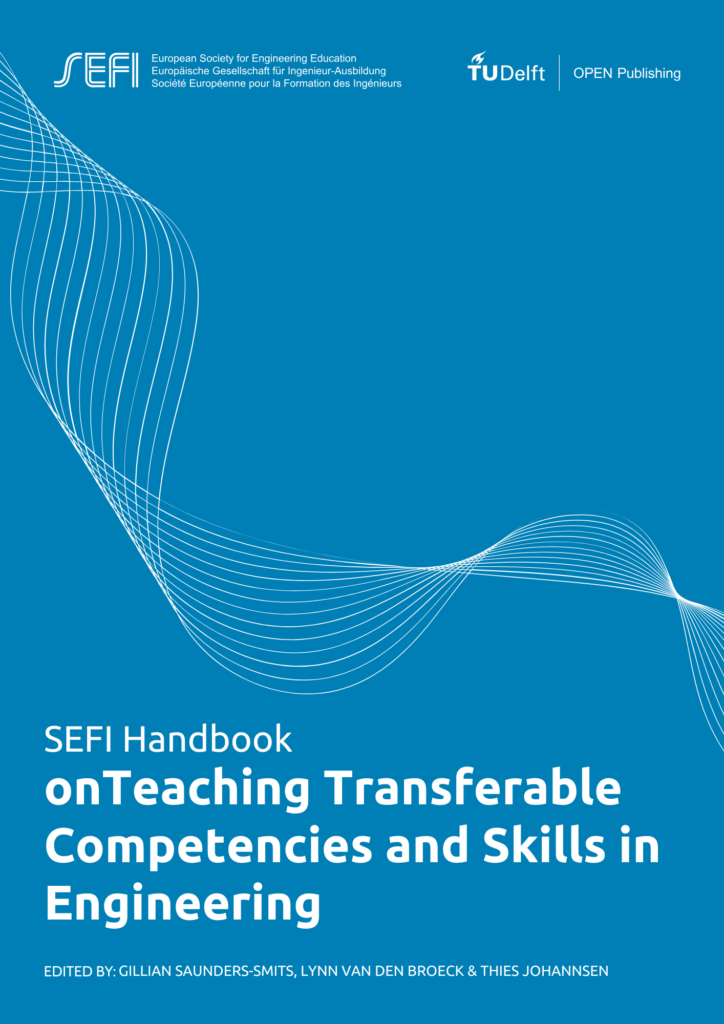
A comprehensive and practice-oriented resource for engineering education
The SEFI Handbook on Teaching Transferable Competencies and Skills in Engineering is approaching publication.
Bringing together the expertise of 155 contributors from 56 different higher education institutes and professional organisations from 23 countries spread over five continents, the handbook provides a comprehensive, evidence-informed and practice-oriented resource for engineering educators, curriculum developers, programme leaders, educational researchers and students seeking to foster transferable competencies and skills in engineering education.
Following an extensive international writing, review and editorial process, this open access handbook is now in the final stages of preparation with TU Delft Open Publishing, ready for launch on 9 September at the 54th SEFI Annual Conference in Prague in September 2026.
Highlights
- A comprehensive reference work and practical manual for teaching transferable competencies and skills in engineering education
- 49 chapters by international teams with 155 contributors
- Five parts covering context and challenges, practical implementation, assessment, curriculum-level integration and evaluation
- Evidence-informed guidance combining research and theory with educational practice
- Open access publication by TU Delft Open Publishing (as e-book and a two-volume hard copy)
- Launch at the 54th SEFI Annual Conference in Prague in September 2026
About the Handbook
The European Society for Engineering Education, SEFI, brings together a vibrant network of engineering educators from across Europe and beyond. Drawing on this collective expertise, this handbook offers a comprehensive and practice-oriented resource for engineering educators, curriculum developers, programme leaders, educational researchers, and students seeking to foster transferable competencies in engineering education.
Bringing together the expertise of 155 international contributors, the handbook provides an authoritative yet practical overview of established approaches in the field, situating them within current debates and emerging challenges. It explores key concepts and definitions, frameworks, curriculum design, accreditation, and quality assurance, while offering evidence-informed perspectives on the development and integration of transferable competencies and skills, from individual modules to entire engineering programmes.
In five distinctive parts, the handbook covers selective transferable competencies and skills, translating research and theory into practical guidance for educational practice. Dedicated parts address assessment, showcase exemplary programmes and curricular implementations, and discuss methods for evaluating educational interventions and outcomes. Combining scholarly rigour with practical relevance, this handbook serves as both a reference work and a toolbox for those committed to preparing future engineers for the complex challenges of a rapidly changing world.
From an Idea to the SEFI Handbook
The handbook project was born as an idea in the SEFI Engineering Skills Special Interest Group, with the call for author and contributions launched at the SEFI conference in Lausanne in 2024. It received an exceptionally strong international response. More than 110 team and individual expressions of interest were submitted by over 200 individuals, representing prospective contributors from five continents.
Since then, the project has developed through an extensive collaborative writing, review and editorial process. Wherever possible, international and multi-institutional author teams have brought together different disciplinary, institutional and geographical perspectives.
Editorial Team
Lead Editors
Gillian Saunders-Smits
TU Delft, the Netherlands
Lynn Van den Broeck
KU Leuven, Belgium
Thies Johannsen
TU Berlin, Germany
The lead editor team has overseen the development of the handbook from its initial conception through chapter development, review and preparation for publication.

In the picture from left to right: Lynn Van den Broeck, Gillian Saunders-Smits, Thies Johannsen. Photo from Gillian Saunders-Smits.
Associate Editors
The lead editor team was supported by a team of Associate Editors overseeing Parts 2–5.
Part 2 – Embedding Transferable Competencies and Skills in Your Classes
Kurt Coppens
KU Leuven, Belgium
Matteo Di Benedetti
University of Sheffield, United Kingdom
Helena Kovacs
EPFL, Switzerland
Abel Nyampfene
University College London, United Kingdom
Part 3 – Assessing Transferable Competencies and Skills
Esther Perea Borobio
Ravensbourne University London, United Kingdom
Jennifer Griffiths
University College London, United Kingdom
Part 4 – Embedding at the Curriculum Level: Current State of the Art
Neil Cooke
University of Birmingham, United Kingdom
Emanuela Tilley
University College London, United Kingdom
Part 5 – Evaluating Needs, Interventions, and Outcomes of Transferable Competencies and Skills
Natascha van Hattum-Janssen
Saxion University of Applied Sciences, the Netherlands
Esther Ventura-Medina
Eindhoven University of Technology, the Netherlands
Contents
The handbook is organised into five parts across two volumes.
Part 1 – Competencies and Skills: Context & Challenges
1.1 Introduction: Why We Need Transferable Competencies and Skills in Engineering Education
Thies Johannsen, Gillian Saunders-Smits, and Lynn Van den Broeck
1.2 The Definition of Competency and Skills in an International Context
Sofie Craps, Helena Kovacs, Roger Hadgraft, Roger Penlington, and Anette Kolmos
1.3 Competency Frameworks of Use to Engineering Educators
Grant Penny, Ann-Kristin Winkens, Neil Cooke, and Esther Perea Borobio
1.4 Quality by Design: The Role of Accreditation in Transferable Competencies and Skills Development
Darren Carthy, Richard Lillington, and José Carlos Quadrado
1.5 Transferable Competencies and Skills: The Framework Underpinning this Handbook
Gillian Saunders-Smits, Lynn Van den Broeck, Esther Perea Borobio, and Thies Johannsen
Part 2 – Embedding Transferable and Skills in Your Classes
2.1 Introduction to Embedding Individual Transferable Competencies and Skills
Thies Johannsen and Matteo Di Benedetti
2.2 Process Management on a Process Level
Faith Nightingale and Raffaella Manzini
2.3 Meeting Skills in Engineering Education: Practical Strategies for their Effective Development
Ryan Grammenos and Jevgenija Prisutova
2.4 Risk Analysis and Risk Management Skills
Claire Lucas and Diana Martin
2.5 Engineering Leadership Development: An Integrated Framework for Practice
Ewa Marjańska, Cindy Rottmann, Meagan R. Kendall, and Anna Maria Trzaskowska
2.6 Teamwork
Éva Kalmár, Siqing Wei, Yousef Jalali, and Homero Murzi
2.7 Oral Presentation
Patrick van Delft and Martijn Wackers
2.8 Written Communication and Reporting
Oscar P.J. van Putten and Angeniet E. Kam
2.9 Embedding the Core Triad: Spatial Ability, Visualisation, and Representational Literacy
Nathalie Al Kakoun, Rehan Shah, and Ilanthiraiyan Sivagnanamoorthy
2.10 Teaching Interpersonal Communication: Listening, Adaptive Communication and Interconnection Skills
Vladislav Krivoshchekov, Ina Peters, Sabine Ammon, and Siara Isaac
2.11 Feedback for Learning in the Engineering Disciplines
Leah M. Ridgway, Aled W. Davies, Greg McNamara, Brendan Hayes, and Ceri Morris
2.12 Cultivating Feedback Literacy in Engineering Education and Professional Practice
Stephanie Fuchs, Jennifer Meyer, Jonathan Butcher, and Alexandra Werth
2.13 Fostering Self-Regulated Learning Among Engineering Students
Shan Tuyaerts, Lynn Van den Broeck, Vicent Rutagangibwa, Peter Ruijten-Dodoiu, and Tinne De Laet
2.14 Adaptability in Engineering Education
Samantha Brunhaver
2.15 Cultivating Student Resilience: Individual Capacity and Institutional Responsibility
Natalie Wint, Stephanie J. Lunn, Inês Direito, and Curwyn Mapaling
2.16 Information Literacy
Natalie Wint, William Bennett, Deborah Bauder, Cristina Tripon, and Freeha Azmat
2.17 Autonomous Motivation, Learning Beliefs and Learner Identity
Dan Jiang, Olga Pierrakos, and Nathalie Al Kakoun
2.18 Initiative and Perseverance in Engineering Education
AraOluwa Adaramola, Nathalie Al Kakoun, and Alexandra Werth
2.19 From Evidence to Practice: Transferable Competencies and Skills in Engineering Education
Thies Johannsen, Matteo Di Benedetti, Helena Kovacs, and Abel Nyamapfene
Part 3 – Assessing Transferable Competencies and Skills
3.1 Navigating the Complexities of Competency Assessment: An Introduction
Faith Nightingale, Pleun Hermsen, Esther Perea Borobio, Jennifer Griffiths, and Lynn Van den Broeck
3.2 Peer Assessment
M. Pilar Garcia-Souto, Arsam Nasrollahy Shiraz, Ademola Odunsi, Esther Ventura-Medina, Will Newton, and Justin Siefker
3.3 Self-Assessment in Engineering Education
Peter A. M. Ruijten-Dodoiu, Rachel Figard, and Samantha Brunhaver
3.4 Assessment Rubrics: Design, Development and Implementation
Folashade Akinmolayan Taiwo and Erik Vellinga
3.5 Observations and the Assessment of Behaviours
Francesco Ciriello, Ali Jaber, and Claire Lucas
3.6 A Transferable Competency Portfolio Based on the Personal Development Process
Rani Dujardin, Lynn Van den Broeck, and Greet Langie
3.7 Inclusive and Ethical Assessment
Ceri Morris, Aled Davies, María Oliveri, and Kerrie Douglas
Part 4 – Embedding at the Curriculum Level: Current State of the Art
4.1 Transferable Competencies and Skills as Fundamental to Engineering Curricula: Introduction and Lessons from Ten Institutional Case Studies
Neil Cooke and Emanuela Tilley
4.2 A Systems Approach to Transferable Skills in PBL-Based Engineering Education: The Aalborg University Case
Aida Guerra, Bente Nørgaard, Bettina Dahl, Dan Jiang, Henrik Worm Routhe, Jette E. Holgaard, Juebei Chen, Søren Hansen, and Xiangyun Du
4.3 Teaching and Learning Professional Competencies through an Integrated Learning Path in the Faculty of Engineering Technology at KU Leuven
Sofie Craps, Jeroen Lievens, Dimitri Coppens, Eef Soete, Bart Van Riet, Dorine Bruneel, and Greet Langie
4.4 Developing Transferable Sustainability and Entrepreneurship Competencies through Vertically Integrated Projects at the University of Strathclyde
Scott Strachan, Thomas Devaney, and Stephen Marshall
4.5 Integrating Self-Directed Learning: Professional and Personal Development in the Industrial Design Bachelor Programme at Eindhoven University of Technology
Sonia M. Gómez-Puente, Linda Martens, Annaluisa Franco, and Yuan Lu
4.6 Integrated Engineering at University College London: Embedding Transferable Skills using PBL, Illustrated by the Biomedical Engineering Degree Programme
Mauryn C. Nweke, M. Pilar Garcia-Souto, Rebecca Yerworth, John E. Mitchell, Fiona R. Truscott, Adam Gibson, Eve Hatten, Jennifer Griffiths, and Emanuela Tilley
4.7 Multi-Level Integration: Transferable Skill Development at the University of Birmingham
Neil Cooke, Claudia Favero, Tom Harrison, Aziza Mahomed, Khadijat Olorunlambe, Zena Green, Carl Anthony, Holly Foss, and Mark Sterling
4.8 University of Melbourne: A Programme-Wide Framework for Teaching, Practicing and Assessing Teamwork
Shannon A. Rios and Sally A. Male
4.9 Embedding Transferable Competencies and Skills in Engineering Curricula: A Comparative Case Study of the University of Sydney and the University of Technology Sydney
Tania Machet, Keith Willey, Jeremy Lindeck, David Lowe, Tom Goldfinch, and Anthony Kadi
4.10 Engineering Innovation and Leadership at The University of Texas at El Paso
Nichole Ramirez, Roger Gonzalez, Meagan Kendall, Peter Golding, Lucas Galey, and Lori Houghtalen
4.11 Authentically Integrating Communication in the Undergraduate Engineering Curriculum within Cornell Duffield College of Engineering
Allison Hutchison, Traci Nathans-Kelly, Suzanne Lane, Cameron Mozafari, Rick Evans, and Hua Wang
Part 5 – Evaluating Needs, Interventions, and Outcomes of Transferable Competencies and Skills
5.1 Evaluating and Researching Transferable Competencies and Skills
Esther Ventura-Medina, Natascha van Hattum-Janssen, and Gillian Saunders-Smits
5.2 How to Evaluate the Relevance of Skills and Competencies
Johanna Naukkarinen, Sarah Jayne Hitt, Tina Baradaran, and Virve Murto
5.3 How to Evaluate Education Outcomes
Ester Gimenez-Carbo, Adesola Adetunji, Franch Maverick A. Lorilla, and Irene Josa
5.4 Evaluating Interventions That Develop Transferable Competencies and Skills
Joelyn de Lima, Siara Isaac, Oxana Sachenkova, Rucha Joshi, and Erna Engelbrecht
5.5 Conducting Comparative Reviews of Transferable Competencies and Skills Instruction across Institutions
Lydia Wilkinson and Jillian Seniuk Cicek
5.6 Dissemination: Sharing Your Work and Finding Your Audience
John E. Mitchell and Gareth Thomson
Publication Information
Book title: SEFI Handbook on Teaching Transferable Competencies and Skills in Engineering
Lead Editors: Gillian Saunders-Smits, Lynn Van den Broeck, and Thies Johannsen
Publisher: TU Delft Open Publishing
Format: E-book / Two volumes hard copy
Structure: 48 chapters in five parts plus a comprehensive Glossary and Index
Contributors: 155 international contributors
Publication date: 2026
Open Access: https://www.tudelft.nl/open-publishing
Launch at SEFI 2026 in Prague
The publication of the SEFI Handbook on Teaching Transferable Competencies and Skills in Engineering marks the culmination of an extensive international collaboration within and beyond the SEFI community.
The handbook will be launched at the 54th SEFI Annual Conference in Prague in September 2026, providing an opportunity to introduce the completed work to the engineering education community and to demonstrate how it can support teaching practice, curriculum development, assessment, educational research and institutional change.
Further information on the handbook and access to the open-access publication will be shared after the launch on 9 September 2026 at the SEFI Annual Conference in Prague.
More information about the SEFI Annual Conference 2026 is available on www.sefi2026.eu.
Related Posts