This episode features Andrew Valentine (University of Melbourne). We talk about his paper published within the European Journal of Engineering Education, entitled, Enhancing the Measurement of Employability in Engineering: Insights from a Systematic Literature Review.
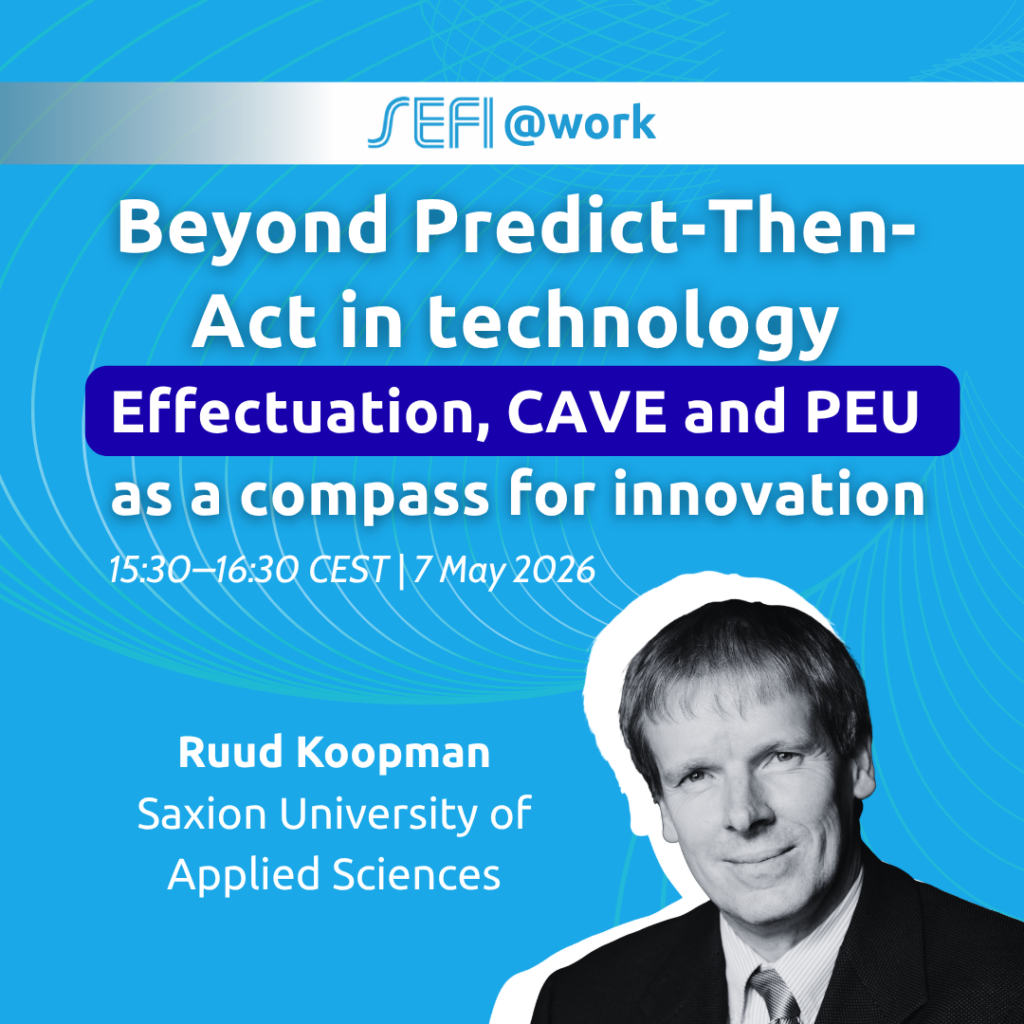
This session will show why classic predict-then-act approaches fall short in dynamic, ambiguous contexts, and how you can act faster and smarter with effectuation in technology contexts. We dissect uncertainty with the PEU (Perceived Environmental Uncertainty) typology (state, effect, response) and link each type to appropriate action logics in the CAVE (Causal, Adaptive, Visionary, Effectual) framework: lean (predictive control) when prediction is possible, effectuation (non-predictive control) when commitments enable progress. With examples from technology and data-intensive projects, we translate this into possible tools (PEU-quick scan, effectual asks/commitment log) and show how to combine them with research integrity and a practical orientation in higher professional education. Participants leave with decision rules: when to use hypothesis tests, when to use commitments, and how to switch between them.
Speakers:
- Dr. Ir. Ruud Koopman, Senior Lecturer Entrepreneurship, ECSB Country VP Netherlands, Saxion | University of Applied Sciences | School of Commerce & Entrepreneurship
- Asif Khan (moderator), Saxion | University of Applied Sciences
This SEFI@work is brought to you by the SEFI Special Interest Group on Entrepreneurship. (SEFI members can join this group)
Related Posts