
Our Core Position
The SEFI SIG on Entrepreneurship, aligned with SEFI’s mission, asserts that entrepreneurial competence is a core professional engineering capability, not a peripheral or extracurricular activity.
As technical execution becomes increasingly automated and collaborative with artificial intelligence, an engineer’s value moves upstream. Future engineers must transition from technical executors into directors and validators who can navigate ambiguity. We work to embed the capabilities of innovation, entrepreneurship, opportunity recognition, risk mitigation, and value creation directly into core engineering curricula with academic rigor and institutional coherence.
Our mission is to help engineering faculties across Europe integrate these capabilities into core curricula with academic rigor, pedagogical credibility, and institutional coherence.
Global Framework Alignment
Our strategic approach aligns with major global standards for education quality and workforce readiness: United Nations (SDG 4 / UNESCO), European Union (EntreComp / HEInnovate), World Economic Forum (WEF) and Accreditation Bodies.
Why Join Us?
We are a European network of educators, researchers, practitioners and ecosystem partners collaborating to move engineering programs past common failure modes, like isolated electives or superficial business pitches, towards durable learning pathways that prepare graduates for a volatile technological landscape.
Our Core Pillars of Practice
We advocate for practical, verifiable principles to develop student capabilities under uncertainty:
- Explicit Outcomes: Define entrepreneurship as a learnable competence focusing on problem framing and opportunity creation.
- Lifecycle-Based Practice: Anchor experiential learning within complete product and system lifecycles, utilizing AI as an accelerator rather than a replacement for judgment.
- Ecosystems as Co-Educators: Partner with industry accelerators, startups, and public actors to expose students to authentic market, regulatory, and human constraints.
- Rigorous Assessment: Evaluate the logic of problem framing, systemic iteration, and validation criteria over mere presentation polish.
Meet our Special Interest Groups at SEFI 2026
List of SEFI Special Interest Groups (SIGs) and their activities at the Annual Conference in Prague, Czech Republic 7-10 September 2026, Czech Technical University in Prague SEFI activities take place year-round, primarily within our Special Interest Groups. Below is an…
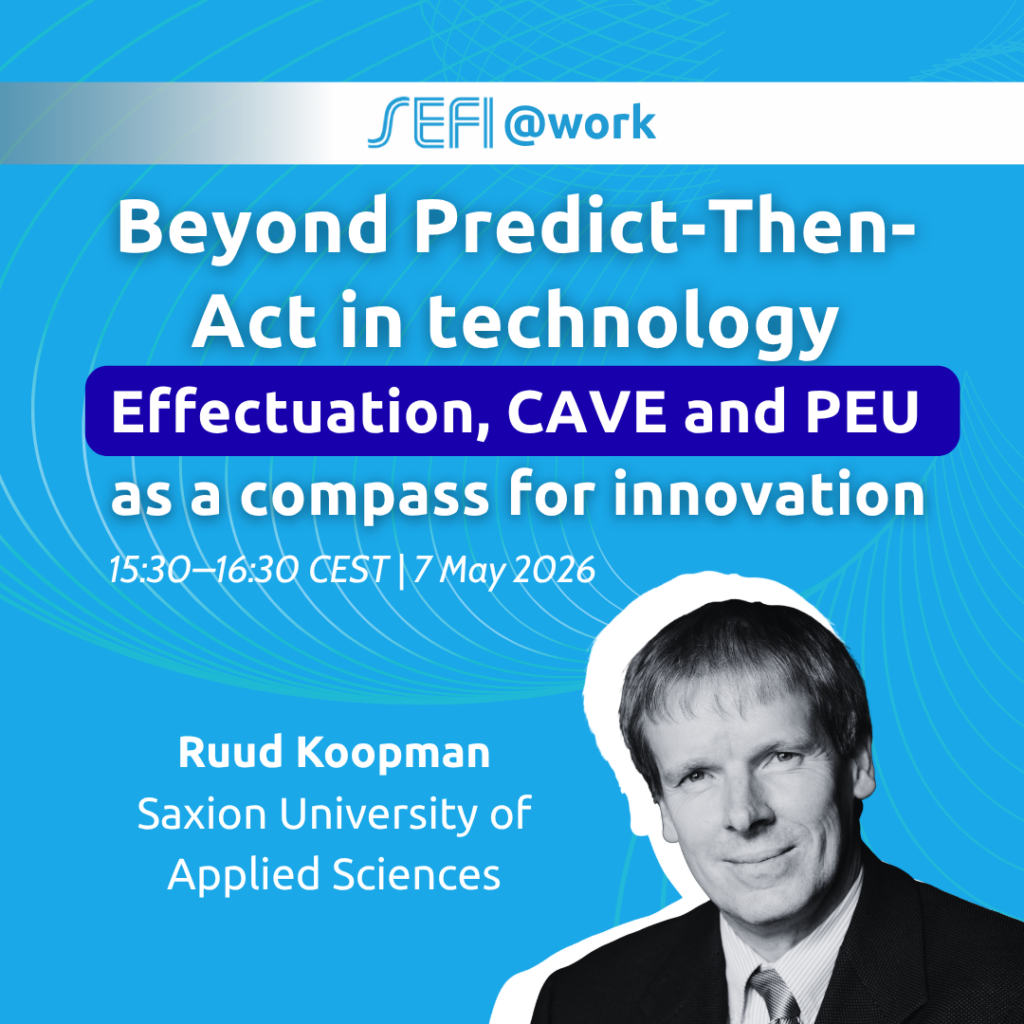
SEFI@work | Beyond Predict-Then-Act in technology: Effectuation, CAVE and PEU as a compass for innovation
7 May 2026
This session will show why classic predict-then-act approaches fall short in dynamic, ambiguous contexts, and how you can act faster and smarter with effectuation in technology contexts.
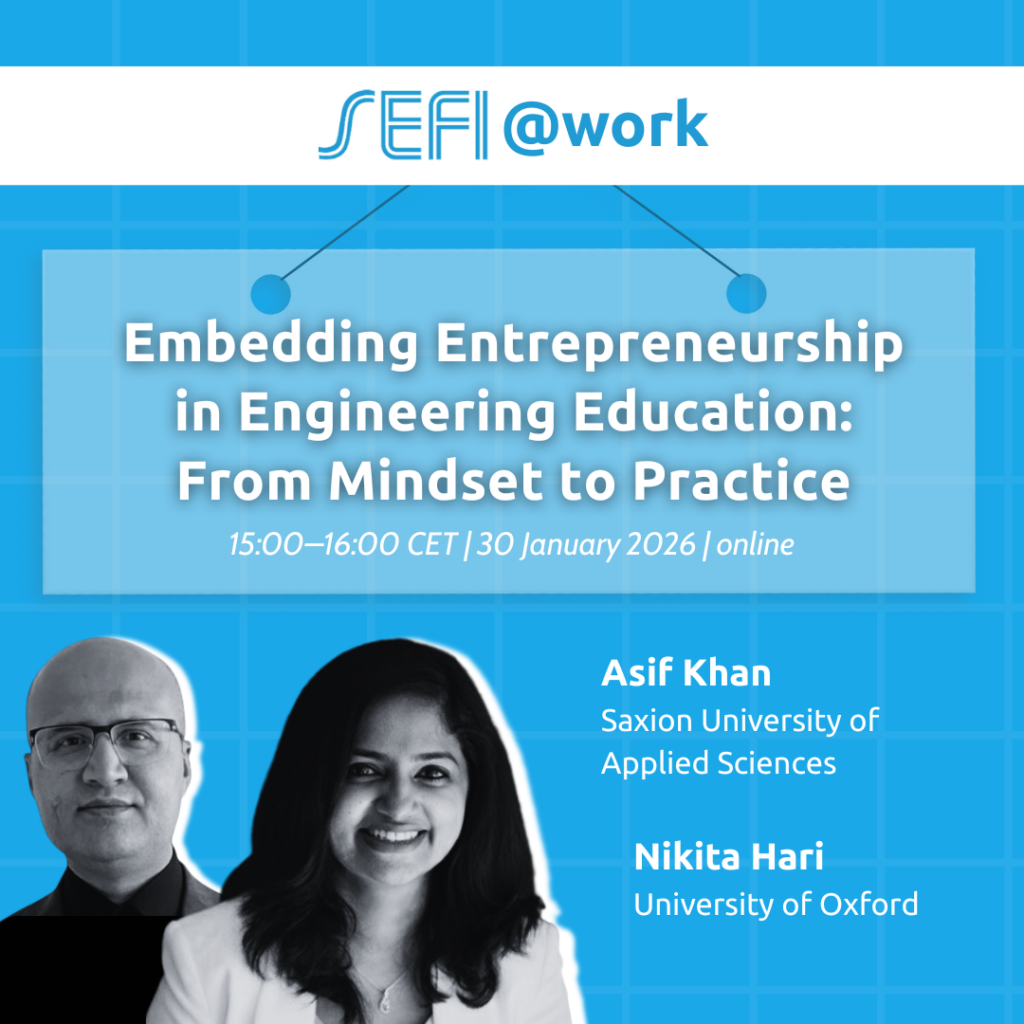
SEFI@work | Embedding Entrepreneurship in Engineering Education: From Mindset to Practice
30 January 2026
This webinar invites a shared exploration of how entrepreneurship can be embedded within engineering education, moving from aspiration and mindset to everyday teaching practice.
SEFI launches Special Interest Group on Entrepreneurship in Engineering Education – Join now!
24 November 2025
SEFI proudly introduces its new SIG on Entrepreneurship in Engineering Education!